Brain Was Building Silicon Valley in a Cage: The Eerily Prescient Tech of Pinky & the Brain
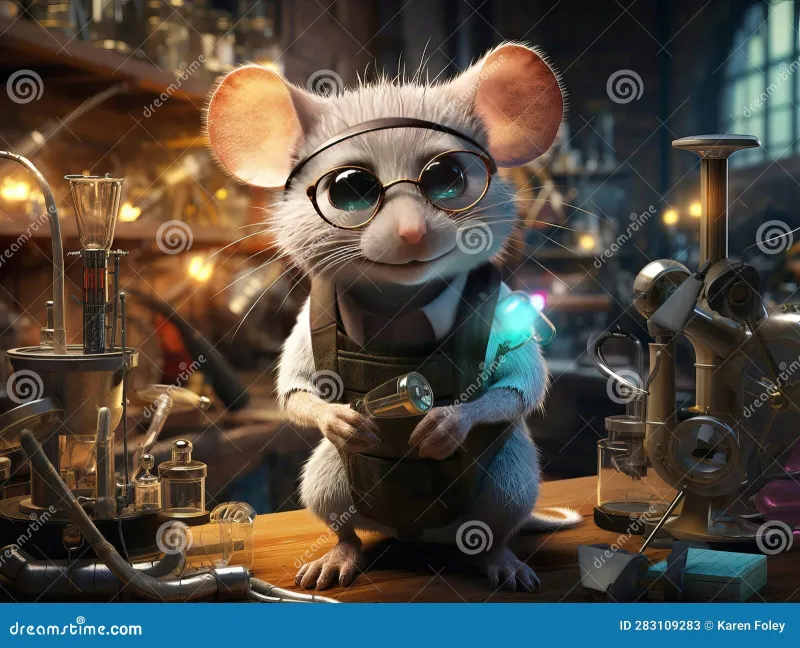
Photo: cartoon scientist lab mouse futuristic gadgets invention blueprint, via thumbs.dreamstime.com
Let's be honest. When Pinky and the Brain first aired on Animaniacs in 1993 before spinning off into its own glorious series, most viewers were too busy laughing at Pinky's "Narf!" to notice what was actually happening in the background. Brain — that oversized-craniumed, perpetually disappointed genius — was quietly sketching out the next thirty years of consumer technology. In crayon. Between escape attempts.
We're not saying Brain invented the internet. We're just saying he definitely would have monetized it better than anyone currently running a social media platform. Let's dig into the gadgets, gizmos, and absolutely unhinged contraptions from the show that turned out to be less "animated absurdity" and more "product roadmap."
The Brainwave Analyzer: Neural Interfaces Were Always the Plan
In multiple episodes, Brain whips out some variation of a device designed to read, manipulate, or broadcast thoughts directly into the minds of an unsuspecting public. At the time, this was pure cartoon villainy. Today, it's a Neuralink press release.
Elon Musk's brain-chip company has been making headlines for years with its promise to merge human consciousness with computers. Neuralink's stated goal — allowing people to control devices with their thoughts — is, functionally, what Brain was attempting every Tuesday night, just with slightly less regulatory oversight. The key difference? Brain's contraptions usually backfired spectacularly. Neuralink's timeline is... let's call it "ongoing."
But the parallel doesn't stop at Neuralink. Meta's research division has been quietly developing non-invasive neural interface wristbands. Amazon has explored voice-activated everything. The dream of bypassing physical interaction and going straight brain-to-machine? Brain had the schematics. He just needed better venture capital.
The Global Hypno-Ray: Algorithmic Persuasion Before We Had a Name for It
Perhaps Brain's most recurring scheme involved some form of mass hypnosis — a device or broadcast capable of simultaneously influencing the behavior of every human on Earth. The joke was always in the execution: something would go wrong, Pinky would sneeze on a critical component, and civilization would narrowly escape a mouse-led oligarchy.
Except here's the thing. Swap "hypno-ray" for "recommendation algorithm" and you've basically described the last decade of social media. Facebook, TikTok, YouTube — these platforms have built extraordinarily sophisticated systems designed to hold your attention, shape your preferences, and nudge your behavior at scale. Billions of people, simultaneously influenced by a centralized system they didn't fully understand or consent to.
Brain's only mistake was trying to build the hardware himself instead of outsourcing it to a startup in Menlo Park and calling it "personalized content delivery."
The Molecular Transporter and the Drone Delivery Industrial Complex
There's a recurring visual shorthand in Pinky and the Brain where Brain needs something — a rare element, a specific tool, a contraption from across the globe — and he engineers an immediate, implausibly fast way to get it. Teleportation, pneumatic tubes, instantaneous fabrication. The point was always the same: friction between wanting something and having it should not exist.
Enter Amazon Prime Same-Day. Enter DoorDash. Enter the entire on-demand economy, which has spent the last fifteen years and approximately all of its venture capital trying to make the gap between desire and fulfillment as close to zero as possible. Amazon is now testing drone delivery in select U.S. markets. Domino's has experimented with autonomous pizza delivery robots. The infrastructure of instant gratification that Brain treated as a narrative convenience is now a multi-trillion dollar industry.
He didn't get credit. He never gets credit.
The World-Dominating App: Controlling Everything Through One Interface
In the later seasons, Brain's schemes became increasingly sophisticated, often involving a single platform or device through which he could exert control over multiple systems at once. One remote. One broadcast signal. One login to rule them all.
Does this sound familiar? It should. Apple's ecosystem — iPhone, Apple Watch, AirPods, Apple TV, HomePod — is explicitly designed to lock you into a single integrated experience where one company mediates your relationship with nearly every aspect of your digital life. Google does the same. So does Amazon with Alexa. The tech industry's defining obsession with "platforms" over products is essentially Brain's unified control scheme, minus the theatrical villain monologue. (Though some earnings calls come close.)
The Cloning Machine and the Rise of AI-Generated Everything
Brain cloned himself. Of course he did. The episode plays it for laughs — the clone is subtly wrong, chaos ensues, Pinky remains delightful. But the underlying anxiety the episode taps into — what happens when you can manufacture a perfect replica of intelligence, creativity, or identity — has become one of the defining cultural conversations of the 2020s.
Generative AI tools can now produce writing, art, music, and video that is functionally indistinguishable from human-created work. Deepfake technology can replicate faces and voices with frightening accuracy. The question of what's "real" versus what's been generated — the exact existential dread that Brain's cloning episode was playing with — is now the subject of congressional hearings and EU regulations.
Brain was just ahead of the ethics committee, as usual.
What This Actually Tells Us About the Show
It would be easy to chalk all of this up to coincidence. Science fiction and speculative animation have always extrapolated from current trends, and any sufficiently creative show will occasionally land close to the truth.
But Pinky and the Brain was doing something slightly different. The show's writers — working under the legendary Tom Ruegger at Warner Bros. Animation — were satirizing the logic of ambition and technology, not just the aesthetics. Brain's schemes weren't random. They followed a consistent internal philosophy: find the single point of leverage that, if controlled, controls everything. That's not just cartoon villainy. That's a pretty accurate description of how platform monopolies, algorithmic systems, and network effects actually work.
Brain understood, intuitively, that the most efficient path to dominance isn't force — it's infrastructure. You don't conquer the world by fighting it. You build the thing everyone depends on, and then you own them by proxy. If that sounds like a certain Seattle-based retailer or a certain Cupertino company, well. Narf.
The Moral of the Story (Such As It Is)
Every episode ends the same way. The scheme fails. Brain recalibrates. Tomorrow night, they do it again. It's a loop that's equal parts tragic and hilarious, and it's part of why the show has endured.
But maybe the real joke isn't that Brain keeps failing. Maybe it's that the humans around him kept succeeding at the exact same plans — and nobody noticed the mouse in the lab who got there first.
Next time you unlock your phone with your face, ask your smart speaker to order you something, or get served an ad for the thing you were just thinking about, remember: somewhere in a fictional genetics lab, a tiny mouse with an enormous head is watching you. And he is not impressed.
Are you pondering what we're pondering? Drop your favorite Brain invention in the comments — and let us know which tech bro you think is secretly a lab mouse in disguise.